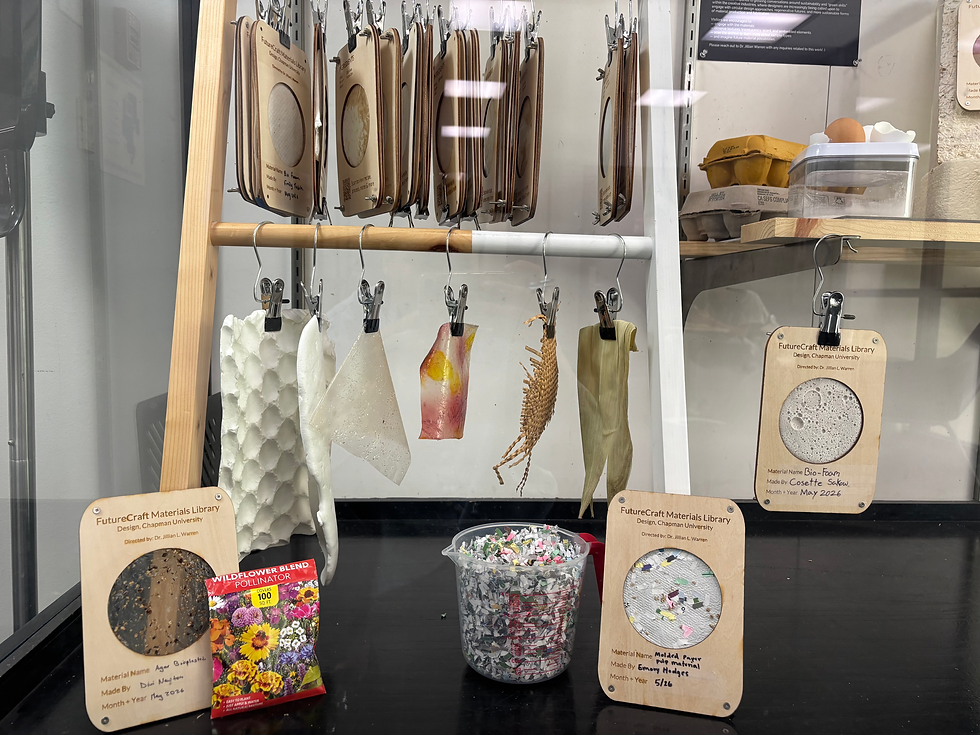
Launching the FutureCraft Materials Library

This semester, students in GD 105 — Prototyping helped launch Chapman University’s first experimental biomaterials library through hands-on exploration of sustainable material practices, alternative fabrication methods, and future material imaginaries.
The FutureCraft Materials Library began as an effort to create a space for material curiosity, critical making, and sustainability-focused prototyping within design education. While many prototyping projects in design classrooms focus on usability, interaction, or outward user testing, this project shifted attention toward materials themselves — asking students to think critically about where materials come from, how they behave, how they age, and what happens to them after use.
Students explored two primary routes of material investigation:
post-consumer waste and reuse
biomaterial making from recipes and earth-derived ingredients
Working with recycled plastics, recycled paper pulp, natural pigments, flower seeds, dehydrated fruit waste, algae-based materials, gelatin, and other organic additives, students engaged with prototyping as a form of exploration and reflection rather than optimization.
Many of the samples intentionally embrace unpredictability, translucency, scent, embedded materials, decomposition, irregularity, and change over time. Rather than hiding imperfection, students were encouraged to think about how temporality, biodegradability, compostability, and material lifecycles might become meaningful parts of future design practices.
This work was guided in part by themes connected to the FutureCraft Cards, which encourage reflection around concepts such as:
circular systems
regenerative thinking
waste reduction
material afterlives
sustainable fabrication
biomaterial practices
and speculative futures
Through direct engagement with materials, students reflected on the role designers play in shaping the environmental impacts of products, systems, and experiences — not only during use, but across entire material lifecycles.
Each material prototype was paired with a custom laser-cut archive card created using the xTool laser cutter. These cards serve multiple purposes:
documenting recipes and ingredients
supporting interaction and tactile engagement
allowing samples to be compared over time
and creating a growing archive of evolving material experiments

Because many biomaterials continue to shift, warp, dry, discolor, soften, harden, or decompose over time, the library is intentionally designed as a living archive rather than a static collection.
This project also connects to growing conversations around sustainability and “green skills” within the creative industries. Recent reports from organizations like the Design Council have identified sustainability as one of the largest emerging skills gaps across creative sectors — emphasizing the need for future designers to engage with regenerative systems, material literacy, circular design approaches, and sustainable production methods.
The FutureCraft Materials Library is intended not only as a Prototyping project, but as an evolving resource for future experimentation, reflection, and conversation around the role of materials in shaping more sustainable futures across our Design Program, Art Department, the wider Chapman community, as well as a resource for FutureCraft workshops and research that extends beyond our campus walls.
We invite Chapman and local visitors to:
experience the physical materials
observe textures, translucency, scent, and embedded elements
compare changes over time
and imagine alternative material futures.